
AI Sector Daily Digest — June 13, 2026
The US government ordered Anthropic to shut down its two most powerful models worldwide after citing a cybersecurity jailbreak, while SpaceX closed its Nasdaq debut up 19% at $161 — the largest IPO ever. State attorneys general launched a formal investigation into OpenAI ahead of its planned IPO. Google released DiffusionGemma, a diffusion-based open model that generates text 4x faster than autoregressive models. Princeton researchers beat Google's formal math theorem system with a $294 solution that outperformed a $170,000 approach.

The US government order that shut down Anthropic's two most advanced models for every user worldwide arrived Friday evening with no advance warning and no specific technical evidence attached. Meanwhile, SpaceX confirmed its record IPO debut, a coalition of state attorneys general opened a formal investigation into OpenAI, Google released the first credible alternative architecture to autoregressive text generation, and Princeton researchers proved formal math theorems for $294 — versus a Google system that cost $170,000 for a worse result. Five stories for Saturday, June 13, 2026.
1. US orders Anthropic to pull Fable 5 and Mythos 5 worldwide, citing a jailbreak
The US Commerce Department issued an export control directive Friday evening ordering Anthropic to suspend access to its two newest models — Claude Fable 5 and Claude Mythos 5 — for all foreign nationals. Because complying with that order while maintaining service for everyone else was not feasible, Anthropic disabled both models for all users globally. 1
The government's stated rationale was a discovered method of bypassing Fable 5's cybersecurity guardrails. Anthropic said the directive arrived at 5:21 pm Eastern with no written technical justification — only verbal confirmation that officials believed a narrow, non-universal jailbreak existed. The company pushed back directly: "We disagree that the finding of a narrow potential jailbreak should be cause for recalling a commercial model deployed to hundreds of millions of people." 2 Anthropic noted that the same jailbreak reportedly works on OpenAI's GPT-5.5 — which is not subject to the same restriction.
Amazon's cloud unit AWS confirmed late Friday that Anthropic had asked it to revoke access in all regions.
正在加载内容卡片…
The action sits inside a longer conflict. The Trump administration declared Anthropic a "supply chain risk" in March after the company refused contract terms that would have allowed its models to be used for autonomous weapons and mass domestic surveillance. That Pentagon blacklisting is currently being challenged in federal court. A separate dispute appeared to be softening as recently as this week, making Friday's directive unexpected even by industry observers. Former White House AI official Dean Ball, who helped write the administration's AI Action Plan, described the order as "cartoonish," noting the logical difficulty of restricting foreign access to Anthropic's models while simultaneously supporting export of advanced AI chips to China.
Access to Claude Opus 4.8 and all earlier models was not affected. Anthropic said it believes the situation is a "misunderstanding" and is working to restore access.
2. SpaceX closes first day up 19% at $161, confirming record IPO
SpaceX completed its Nasdaq debut on Thursday, June 12, with shares closing at $160.95, up 19% from the $135 IPO price. The stock opened at $150 and reached an intraday high of $176.52 before settling back. At closing price, SpaceX's market cap stood at approximately $2.1 trillion — the highest valuation of any company at IPO close in history. 3 4
The offering raised $75 billion — the largest single IPO raise on record. Elon Musk's net worth crossed $1 trillion on the opening trade, making him the first individual to reach that figure. SpaceX President Gwynne Shotwell rang the Nasdaq opening bell.
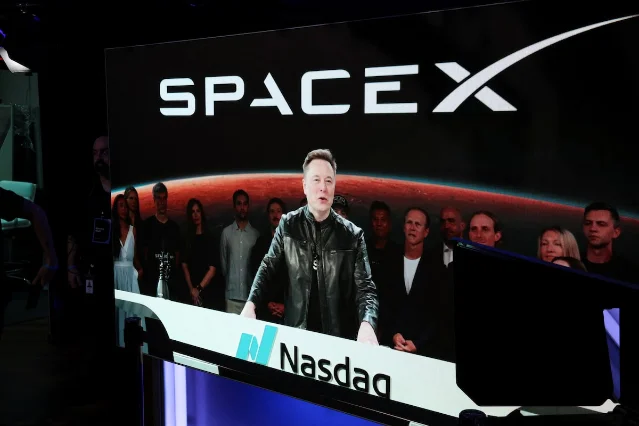
For the AI sector, the debut carries specific significance: Anthropic and OpenAI both have confidential S-1 filings with the SEC and are targeting public listings later this year. A disorderly or disappointing SpaceX debut would have given both companies reason to delay. The 19% first-day gain, while large in absolute terms, is within the range analysts described before listing as an "orderly debut" — sufficient to validate AI infrastructure valuations without raising questions about bubble pricing. 5
CFRA analyst Keith Snyder initiated coverage on the same day with a Sell rating and a $115 price target — roughly 32% below the intraday high — citing the 109x trailing revenue multiple and the assumption that both Starship and xAI must succeed for the valuation to hold.
MSCI began including SPCX in its large-cap indices on Saturday (today), creating the first wave of mandatory passive-fund buying. Nasdaq-100 eligibility is expected around early July.
3. State attorneys general open investigation into OpenAI
A coalition of US state attorneys general has opened a formal investigation into OpenAI, the Wall Street Journal reported Friday evening. The probe involves requests for documents covering user safety and data practices. 6 7
Florida's attorney general filed a separate lawsuit against OpenAI and CEO Sam Altman, alleging the company knowingly released an unsafe product and ignored internal warnings. OpenAI said it is "engaging constructively" with the attorneys general. 8
The timing is notable. OpenAI filed its own confidential S-1 with the SEC on June 8 and has signaled it is targeting a public listing in the second half of 2026. A multi-state investigation disclosure in an S-1 is a material risk factor; the question for IPO bankers is how active the probe becomes between now and pricing.
The investigation is distinct from existing litigation OpenAI faces from publishers and authors over training data. State AGs have jurisdiction over consumer protection, deceptive practices, and — in several states — AI-specific regulations that have taken effect this year.
OpenAI logo. 8
4. Google releases DiffusionGemma: 4x faster text generation, different architecture
Google DeepMind released DiffusionGemma this week — an experimental open model that generates text using a diffusion process rather than the standard one-token-at-a-time autoregressive approach used by ChatGPT, Claude, and Gemini. 9 10
The model starts with 256 random tokens and refines them in parallel across multiple denoising steps — the same conceptual approach image generators like Stable Diffusion use on pixel grids, now applied to text. The result: over 1,000 tokens per second on a single NVIDIA H100 GPU, and 700+ tokens per second on a consumer RTX 5090.
Technical specs: 26 billion parameters, Mixture-of-Experts architecture with 3.8 billion active parameters per inference pass. Quantized, it fits in 18–24 GB of VRAM. Released under Apache 2.0 with day-zero support in vLLM and Hugging Face Transformers. NVIDIA has optimized it for GeForce RTX GPUs and DGX Spark.
Google is explicit about the trade-off: DiffusionGemma scores lower than standard Gemma 4 on MMLU and coding benchmarks. It is positioned for speed-critical local workflows — in-line editing, code infilling, rapid draft iteration — not accuracy-critical production deployments. The bigger significance is architectural: this is the first credibly deployed signal that the autoregressive paradigm is not the only viable path for general text generation at scale. If diffusion-based text generation closes the quality gap in subsequent versions while retaining the speed advantage, it could change the cost structure of running AI locally on consumer hardware.
5. Princeton team proves harder math theorems than Google's system for 578x less money
Researchers at Princeton's Language and Intelligence Center published Goedel-Architect, an agentic framework for automated formal theorem proving in the Lean 4 proof assistant. The system achieved a 75.6% pass rate on PutnamBench — a benchmark based on the Putnam Mathematical Competition — for a total cost of $294 in API calls. Google's Gemini-powered Hilbert system achieved a lower 70.0% pass rate on the same benchmark while consuming $170,000 in compute. 11
The efficiency comes from a different search strategy. Most formal proving agents use recursive top-down decomposition — break the problem into sub-problems, break those into smaller ones, letting each layer spend its own compute budget. Goedel-Architect instead builds a global dependency graph of the full proof structure upfront, validated continuously against the Lean 4 compiler, catching dead ends before they consume compute.
The gap between $294 and $170,000 for a better result makes a direct case that agent architecture can matter more than the underlying model. As AI agents take on complex multi-step reasoning tasks in science and enterprise, the difference between a well-constructed agent and a brute-force one could mean the difference between a task costing hundreds of dollars and one costing six figures.
Coverage window: June 12–13, 2026. All stories verified against primary sources.
参考来源
- 1Fortune: Anthropic disables Fable and Mythos after U.S. export ban
- 2Reuters: Anthropic disables top-tier AI models after US order
- 3WSJ: SpaceX shares close up 19% in historic debut
- 4CNBC: SpaceX IPO SPCX live updates
- 5NYT: What the SpaceX IPO means for OpenAI and Anthropic
- 6WSJ: OpenAI investigated by coalition of state attorneys general
- 7Bloomberg: OpenAI probed by coalition of state AGs
- 8CNBC: OpenAI says it's engaging constructively with state AGs
- 9Computerworld: Google unveils DiffusionGemma
- 10HPCwire: NVIDIA accelerates DiffusionGemma for local AI
- 11Unrot: AI News Today June 13, 2026
围绕这条内容继续补充观点或上下文。