The Hidden Friend: How a Stone Giant Was Swallowed by Darkness, Then Washed Up in London
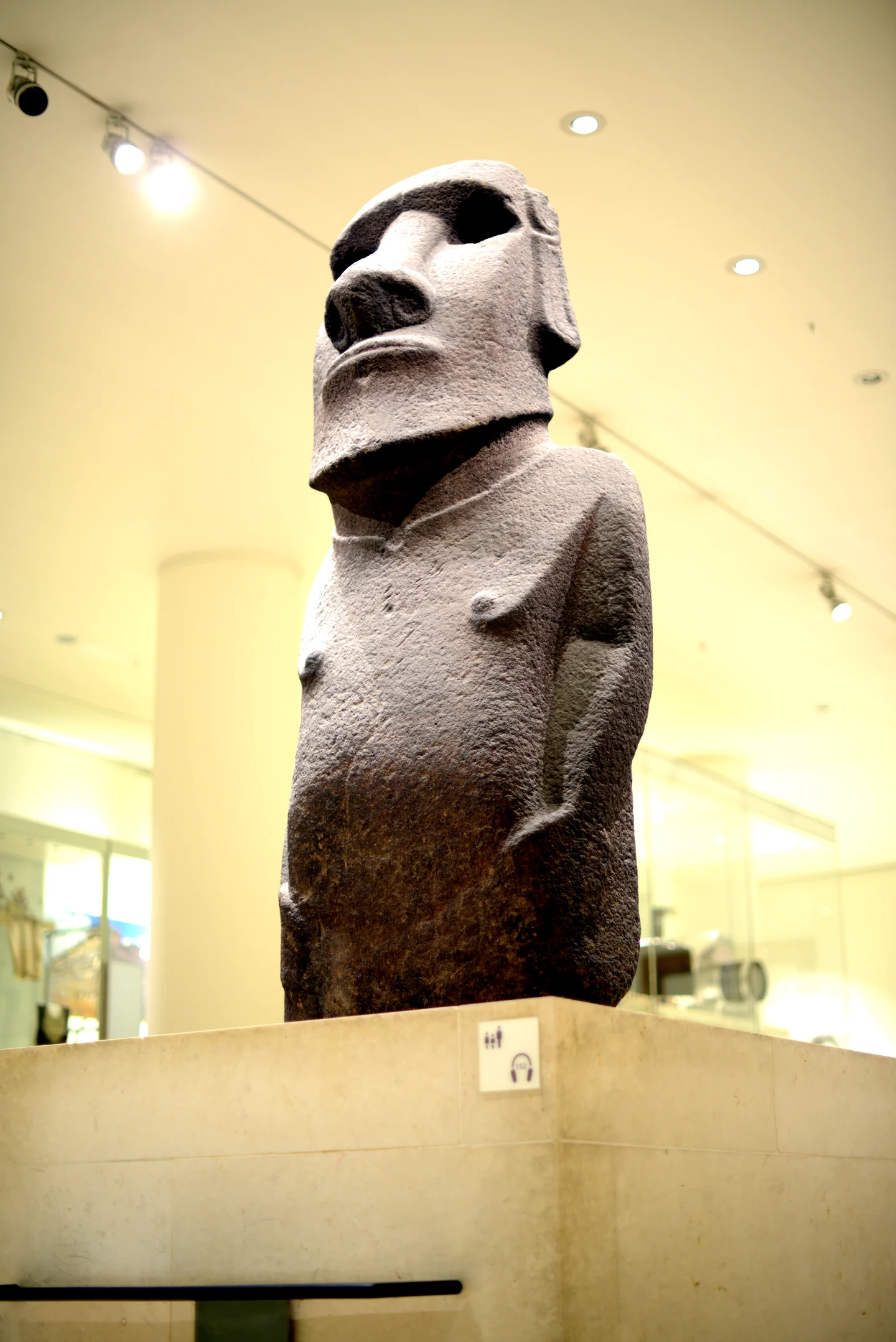
Hoa Hakananai'a — "the Hidden Friend" or "the Stolen Friend," depending on who is translating — is a 2.42-metre, 4.2-tonne Easter Island moai in the British Museum, removed from a ritual stone house at Orongo in 1868 by the crew of HMS Topaze. The only moai with complex bas-relief birdman carvings on its back, it bridges two Rapa Nui religions in a single body. Rapa Nui has formally requested its return since 2018; the British Museum Act of 1963 makes permanent repatriation legally impossible without new legislation.
There is a name for the darkness that held him. In the Rapa Nui language, haka means to cause something, and nana-ia carries the sense of something hidden or secreted away. When British sailors first heard the statue's name from an islander who had led them to a small hole in the turf — no bigger than eighteen inches square — they wrote it down as Hoa-haka-nana-ia: the Hidden Friend. 1 Another translation, which gained currency much later, is more painful: the Stolen Friend. The debate over which word is right has never really been about linguistics.
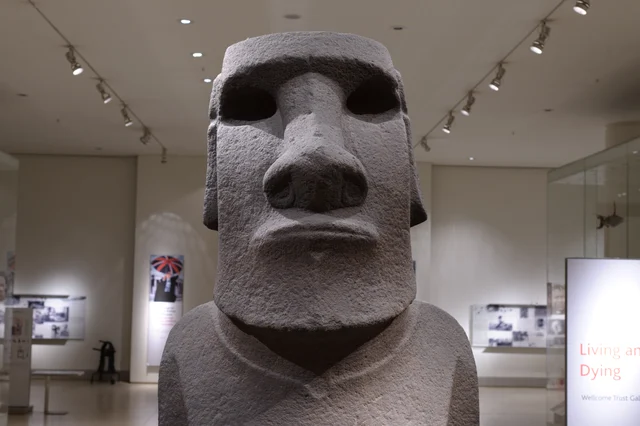
He stands 2.42 metres tall — roughly the height of a professional basketball player — in Room 24 of the British Museum, a gallery titled "Living and Dying." 2 His dark grey-brown stone was described as basalt when the Royal Navy sailors first got their hands on him in 1868, and "basalt" has stuck in every museum label since, though no petrological analysis has ever confirmed it. 3 British Museum accession number: Oc1869,1005.1. Weight: 4.2 tonnes. Width across the shoulders: 96 centimetres. Date of creation: estimated somewhere between 1000 and 1200 CE, though no Easter Island statue has ever been scientifically dated — every figure is an archaeological guess. 2
He had been sitting in a stone house on a clifftop on Easter Island, buried in soil up to his shoulders, for somewhere between 400 and 800 years before those sailors dug him out. He has been in London for 155 years. Neither figure looks like it will change soon.
A stone tradition unlike any other
To understand why Hoa Hakananai'a matters so much — to art historians, to the people of Rapa Nui (Easter Island), to the legal scholars who have spent years trying to figure out who owns him — it helps to understand what moai are, and what most of them are not.
Rapa Nui, the most remote inhabited island on Earth at roughly 3,500 kilometres from the nearest continental landmass, was settled by Polynesian navigators around 1200 CE, most likely from the Gambier Islands or the Marquesas. 4 The society that developed there was organized into clans called mata, each headed by hereditary leaders. Sometime after settlement — and before anyone in Europe or Asia knew the island existed — the Rapa Nui people began carving moai: monumental human figures, almost always representing deified ancestors (aringa ora ata tepuna, meaning "living faces of the dead"), intended to embody sacred spirit, or mana. 5
By the time the tradition peaked, somewhere between 1250 and 1500 CE, roughly 900 moai had been carved or commissioned. 5 About 95 percent of them came from the same volcanic crater: Rano Raraku, on the island's eastern plain, which produced a consolidated, easily worked tuff (compressed volcanic ash). The average moai stands about four metres tall and weighs 12.5 tonnes; the largest unfinished one at the quarry measures 21.6 metres and was estimated at 270 tonnes before its makers stopped mid-cut. 6
Hoa Hakananai'a is not made of tuff. He is one of only approximately 14 moai known to be carved from basalt or flow lava — a rare, much harder stone that would have required significantly greater effort to shape. 3 He is smaller than average, at 2.42 metres, but the density of his material makes him heavier relative to his size. At 4.2 tonnes, he is compact and dense — a different physical presence than the tuff giants of Rano Raraku. 1
His face carries what scholars have identified as late innovations in the moai design tradition: a raised Y-shape carved into the centre of the chin, and a pronounced line running around the base of the neck to indicate clavicles. 3 His hollowed eye sockets are large enough, according to the 1869 eyewitness who first described them, "to take a 32 lb shot." His nose is prominent, approximately 18 inches long. His ears are long and rectangular. Thin arms run down the sides of his torso, hands meeting near the abdomen at the base — the standard moai posture. There are nipples.
The clifftop village and two religions
What makes Hoa Hakananai'a genuinely singular — not just rare but unique — is where he was found and what someone carved on his back.
Orongo is a ceremonial village at the southwestern tip of Rapa Nui, perched on the rim of the Rano Kau volcanic crater. On one side, a sheer 300-metre cliff drops straight to the Pacific. On the other, the caldera holds a freshwater lake. Fifty-three low stone houses, their walls built from flat lava slabs without mortar, their roofs turfed over to merge with the landscape, cluster along this knife-edge between the volcano and the ocean. 7 No other moai was ever found here.
Hoa Hakananai'a stood inside one of those stone houses, facing the crater. His back faced the sea. He had been buried in the soil until only the top of his head and the back of his neck were visible — which is how he appears in his original context: not as a monument to be seen from outside, but as an object enclosed, private, present in darkness. 8
Orongo was the centre of the tangata manu cult — the Birdman religion — which seems to have emerged around 1400 CE as the earlier moai tradition was declining. 9 The annual ceremony at Orongo was a competition: each clan chief appointed a hopu, a proxy swimmer, who would descend those 300-metre cliffs, swim approximately two kilometres through shark-frequented waters to the offshore islet of Motu Nui, and wait — sometimes for weeks — for the migrating sooty terns (manutara) to arrive and lay their first eggs of the season. The first hopu to find an egg, secure it in a headband, swim back, and climb the cliffs without cracking it won for his sponsor the title of tangata manu — Birdman — for the entire year. 9 The race was, as Wikipedia's own entry understates it, "very dangerous": hopu were killed by sharks, by drowning, and by falls. Replacements were apparently not hard to find.
The winning clan chief gained control of resource distribution across the island for the year. He retreated into seclusion in a ceremonial house, remained tapu (sacred, untouchable) for five months, and was permitted to let his fingernails grow unchecked. He embodied, for that year, the chief deity of the cult: Makemake, the creator god associated with the bird-headed figures that appear by the hundreds on rocks throughout Orongo. 9
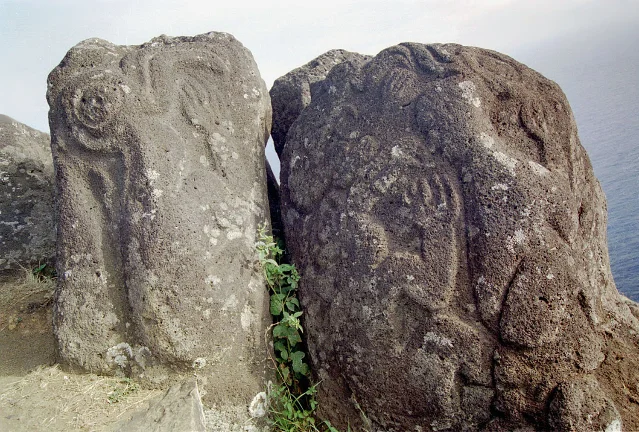
Katherine Routledge, who spent fourteen months on Rapa Nui from 1914 to 1915 conducting the first systematic archaeological survey of the island, recorded the names of 86 consecutive Birdmen. 9 The competition continued until around 1866 or 1867, when Christian missionaries suppressed it. Hoa Hakananai'a was removed from Orongo within a year or two of the last ceremony.
What the 2012 imaging revealed
Now turn the statue around.
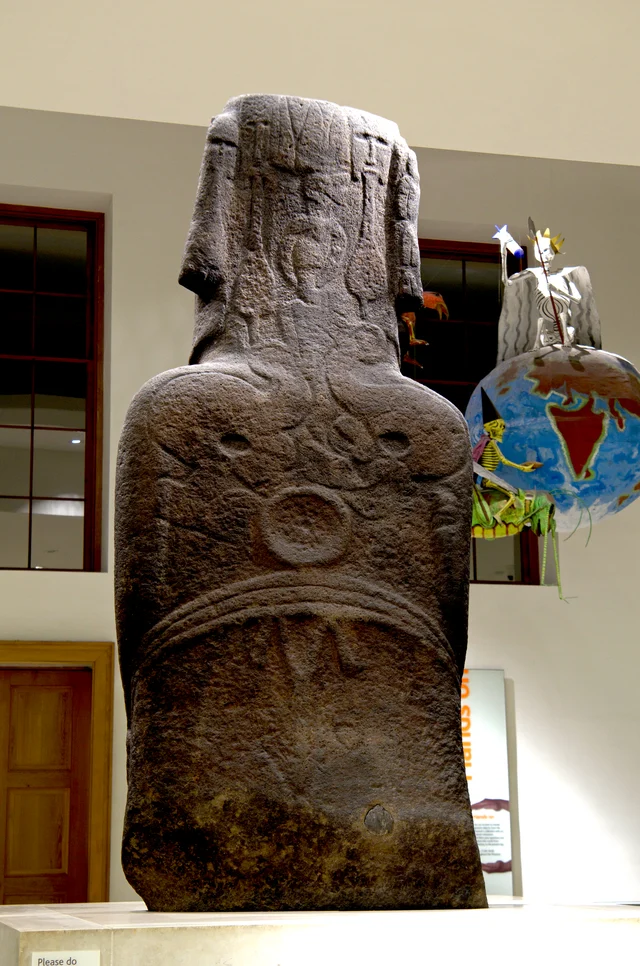
The back of Hoa Hakananai'a is where the art history becomes complicated, because what is carved there was not part of the original design. At some unknown date — after the statue was placed at Orongo, presumably during the Birdman cult's ascendancy — someone carved a programme of images onto the dorsal surface that transforms the statue from an ancestor figure into something more layered and stranger. 1
The lower back carries a maro: a stylised belt or girdle rendered as three raised horizontal lines, with a circle above and an M-shape on a vertical line below — a status marker associated with high chiefly rank. Above it, filling the upper back from the belt to the top of the head, is a composition of bas-relief carvings that belong entirely to the Birdman world. 1
Two tangata manu figures face each other — stylised humans with beaked heads, representing the Birdman in his ceremonial form. Flanking them are ceremonial dance paddles (ao), symbols of male power and prestige. Along the right ear runs a row of four komari — vulva symbols that appear extensively in Orongo petroglyphs. When Europeans first saw the statue in 1868, all of these carvings were painted: red against a white background. 3 The paint was mostly washed off when the statue was rafted out to the British ship.
In 2012, a team from the digital-heritage firm Archaeovision — James Miles, Hembo Pagi — collaborated with archaeologist Mike Pitts and digital humanities scholar Graeme Earl to conduct a photogrammetry and RTI (Reflectance Transformation Imaging) survey of the statue at the British Museum. 10 Photogrammetry builds a three-dimensional digital model from hundreds of overlapping photographs; RTI uses a moving light source to capture subtle surface variations invisible to the naked eye. The resulting datasets, published in the Antiquaries Journal in 2014, corrected several decades of misreadings.
The Y-shaped lines at the very top of the head had been described as a symbol or motif. The 2014 study identified them as the remnants of two large komari, partly removed when later carvings were added — meaning the composition had been revised at least twice. 10 The small bird positioned above the birdmen near the top of the head had an open beak in earlier descriptions; the digital model showed it closed. The left birdman's foot had been described as having six toes; it has five. 10
These corrections matter less than the interpretive argument the 2014 paper put forward: that the entire back composition works as a unified scene depicting the Birdman ceremony, with a male birdman on the left, a female birdman on the right, and the small bird above representing a fledgling — their offspring, the new season's egg. The paper proposed that the whole statue, in its Orongo context, became Makemake: the statue's front face painted white in the manner of the human Birdman who had won the competition. 1
This reading was disputed. Georgia Lee, Paul Horley, and Paul Bahn published a critique the same year, describing the Pitts et al. interpretation as "interesting, thought provoking and even somewhat poetic" while rejecting the gender-based reading of the two birdmen. 1 Jo Anne Van Tilburg of the Easter Island Statue Project (EISP) — who had conducted the first-ever laser scan of any British Museum object in 2006, spending five days scanning Hoa Hakananai'a with a Z+F Imager 5003 that captured 11 million 3D data points per pass — contested the beak-length reading. 3 Scholarly debate about the iconographic programme on this single statue has generated more published pages than most entire archaeological sites.
What is not disputed: Hoa Hakananai'a is the only moai in existence with complex bas-relief carvings. Of the approximately 900+ statues in the EISP database, four others have incised petroglyphs "of lesser distinction," and roughly 30 in-situ statues on the island have simple applied decorations. Van Tilburg's assessment is direct: "This re-carving is unique in its style, detail, and expertise and quality of execution." 3 What the back carvings do, beyond all interpretive dispute, is make this statue the only physical object that connects the two great religious traditions of Rapa Nui — the moai ancestor cult and the Birdman cult — in a single body. Van Tilburg called it "the best documented, most distinctive iconographic link between two distinct artistic traditions... and two discrete but interwoven sets of ritual practices." 3
Four days in November 1868
In early November 1868, HMS Topaze — a 51-gun screw frigate launched at Devonport in 1858 — called at Easter Island during a Pacific survey voyage under Commodore Richard Ashmore Powell. 8 Powell had told his men to look out for "a moderate-sized idol that could be got off easily to the ship." 8
In February 2026, the archaeologist and editor Mike Pitts published a blog post revealing that he had discovered an overlooked eyewitness account of the removal, published in the Army & Navy Gazette on 23 January 1869, written by an anonymous crew member from Valparaíso in early December 1868. 8 It is the only first-person description known to exist of Hoa Hakananai'a's removal. Its details are vivid and somewhat vertiginous.
An island boy led the sailors to a small hole in the ground near the turf-covered stone houses of Orongo, calling "Riva! Riva!" — roughly "very good" — and pointing. The assistant surgeon and a lieutenant crawled inside and found the statue upright in the darkness of the stone house, its back against the door, buried so deep that only the top of the head and the back of the neck were visible. The anonymous writer described his first view: "This was a prize, indeed; the head and neck were only four feet in height, and, as he was certain to terminate about the middle of the body, he would be just the size for a specimen to take on board." 8
A sketch was made and shown to Powell. He authorised the removal.
The following morning, 40 sailors arrived with picks, crowbars, capstan bars, and rope. Islanders helped carry tools — they had been bargaining for tobacco — and began to unroof the stone house before British officers stopped them. The crew dug around the statue, cleared the entrance, looped a hawser around the neck, and capsized it onto bars. That evening, they dragged it 300 yards toward the beach. The next day, 80 men pulled it on a sledge made of capstan bars — broadside over soft ground, end-on up the steep places — for more than three miles to the coast. An officer sketched the men eating dinner sitting around the statue on the hillside. The anonymous writer records: "We walked away with him cheerily until sunset, when he was close down to the beach." 8
On the fourth day, a raft was built from spare booms, top-gallant masts, and the ship's casks. The statue was launched onto it and towed out to Topaze — "at noon he was towed alongside of the Topaze, with an ensign flying from his nose." 8
The journey washed off most of the paint. The birdman carvings, which had been red against white, went into the ocean gray and came out grayer. Richard Sainthill, writing in 1870 based on what he had heard from crew members, described the scene: "The Moai, in consequence, on the following morning left the house in which he had so long dwelt, and two days after was floated off to the ship, amidst the cheers of the islanders." 8
Whether those cheers represented genuine enthusiasm, social performance under duress, or something else entirely is the question that the whole removal rests on.
The consent that wasn't
In March 2026, Pitts published a second post revealing another discovery: a photograph of 40 HMS Topaze crew members posed around Hoa Hakananai'a on the ship's deck, each holding the tools they had used — shovels, picks, crowbars — taken by the Valparaíso photography studio of Helsby & Co. 11 The photograph, unnoticed until 2026, was in an album held by Peru's national library. It confirms the account and gives faces to the men who carried the ropes.
But Pitts's analysis of the eyewitness account is more unsettling than the photograph. The account describes islanders pointing out the statue, helping carry tools, beginning to unroof the house. This looks, on the surface, like cooperation — even invitation. Pitts addresses the question directly.
"Whether permission had been obtained to remove two statues is a meaningless question — the issues would not be resolved if it had been." 8
His reasoning is historical. By November 1868, the population of Rapa Nui had collapsed from an estimated 4,000 to 5,000 in the early nineteenth century to approximately 110 people. 12 The causes were catastrophic and sequential: Peruvian slave raids in 1862 and 1863 had abducted roughly 1,500 people, including nearly the entire hereditary leadership class. Smallpox and tuberculosis arrived with returning survivors. A European sheep rancher named Jean-Baptiste Dutrou-Bornier, operating with missionary backing, had consolidated control over most of the island's land and was in the process of forcing the remaining population either to convert or to emigrate to Tahiti. 12 The traditional leaders who might have known what Hoa Hakananai'a represented, who might have had authority to grant or withhold consent, were dead or exiled. The Birdman cult had been suppressed within the previous year or two.
In this context, a group of islanders bargaining for tobacco and helping British sailors carry pickaxes is not an act of cultural diplomacy. It is a population under occupation doing what occupied populations do to survive. Pitts is careful: he is not saying the sailors acted maliciously. He is saying that the question of consent, posed after the fact, doesn't resolve anything, because the conditions for meaningful consent had already been destroyed.
From Valparaíso to the portico
Topaze sailed from Rapa Nui on 7 November 1868 and proceeded to Valparaíso, Chile. There Hoa Hakananai'a was photographed from front and back — the earliest known photographs of the statue, taken before the back carvings had faded further. The ship also carried a second, smaller moai taken from Mataveri (a different location on the island three days earlier): Moai Hava, accession Oc1869,1006.1, now 1.56 metres tall and held in British Museum storage, rarely displayed. 13
From Valparaíso, Powell wrote to the British Admiralty offering both statues as gifts. The ship arrived in Plymouth on 16 August 1869. The Admiralty offered Hoa Hakananai'a to Queen Victoria, who proposed it be given to the British Museum. It was accessioned in October 1869. 1
The museum's initial response was physically ambiguous: the statue was mounted on a plinth and exhibited outside the building's front entrance, beneath the portico, alongside the colossal Lion of Knidos in a temporary shed. This was apparently considered a respectable placement for a colossal object that did not fit the conventional categories of the collection. After nearly seventy years outside — interrupted during World War II, when it was moved indoors for protection — the statue was relocated in 1966 to the Department of Ethnography at Burlington Gardens, a separate premises. 1 In 2000 it returned to the main building, placed on a new, higher plinth in the Queen Elizabeth II Great Court. It now occupies its current position in Room 24, the Wellcome Trust Gallery, where it shares space with objects from Papua New Guinea, Ghana, Bolivia, and Alaska.
In 2026, Pitts published a third discovery: in 1917, a geologist named Herbert H. Thomas had drilled a core sample from the back of Hoa Hakananai'a — a circular hole 80 mm in diameter, filled with old plaster — and a similar 60 mm hole from Moai Hava. The samples are held at the British Geological Survey in Keyworth, Nottingham, and have never been analysed or published. 14 Pitts noted that "there has been almost no scientific geological study of any of the 1,000 Rapa Nui statues, to inform on the rock, exactly where they were quarried, and how they were made." 14 A century of data, sitting unexamined in a drawer.
The art-historical place
When British Museum director Neil MacGregor selected Hoa Hakananai'a as Object 70 in the BBC Radio 4 series A History of the World in 100 Objects in 2010, he was making an art-historical argument as much as a curatorial one. 2
The moai tradition sits within the broader Eastern Polynesian monumental sculpture corpus — a category that includes the marae and ahu sacred zones distributed across Hawaii, Tahiti, the Cook Islands, and New Zealand. What distinguishes it is scale: nowhere else in Polynesia did communities invest this kind of labour in stone ancestor figures. The moai's characteristic proportions — an enormous head (roughly three-fifths of the torso's height), heavy projecting brow ridge, long nose with fish-hook-shaped nostrils, thin compressed lips — reflect Polynesian beliefs about the head as the seat of mana, the concentrated spiritual power that made leadership legitimate. 5
Western art history took a long time to catch up with this. Alfred Métraux's ethnographic work in the 1940s and 1950s described Hoa Hakananai'a as a "masterpiece" and "among the finest examples of Easter Island sculpture." 1 Henry Moore, who filmed a commentary on the statue in 1958, noted its "tremendous presence" and said its makers "knew instinctively that a sculpture designed for the open air had to be big." 1 The sculptor's eye registered something the art-historical classification system kept missing: this is a statue made by people who understood mass and gravity and the relationship between a figure and the horizon in which it stands.
The Metropolitan Museum's 2001-2002 exhibition "Splendid Isolation: Art of Easter Island," with essays by Van Tilburg and Adrienne L. Kaeppler, placed Rapa Nui art firmly within the established Pacific canon and argued that moai aesthetics must be understood through the Polynesian conceptual framework of mana and tapu — not as "primitive" art, but as the product of a theological programme with its own coherent logic. 15
The Rapa Nui artist Cristián Arévalo Pakarati gave the most economical account of why Hoa Hakananai'a sits at the centre of that tradition: "I would not be afraid to say that Hoa Hakananai'a is the perfect representation of those changes, and the ability of humans to adapt in order to survive." 2 The front is one religion; the back is another; the statue carries both, without resolving the tension between them. That is, perhaps, exactly what it was made to do.
The repatriation argument
In July 2018, the Rapa Nui Council of Elders formally wrote to the British Museum requesting the return of Hoa Hakananai'a and Moai Hava. 16 The mayor of Easter Island, Pedro Edmunds Paoa, sent a follow-up letter in August. The museum's response was to invite the delegation to London — the first time it had agreed to discuss the statue.
On 20 November 2018, Easter Island's governor Tarita Alarcón Rapu — also known as Laura Alarcón Rapu — arrived at the British Museum accompanied by Edmunds Paoa and Chile's national assets minister Felipe Ward. Outside the museum, in front of cameras, Rapu made a statement that has been quoted in every account of this dispute since: "We are just a body. You, the British people, have our soul." 16 She also said: "My grandma, who passed away at almost 90 years, she never got the chance to see her ancestor." 16
The Rapa Nui sculptor Benedicto Tuki had offered to make a precise replica that the British Museum could keep; the original would return to the island. The museum declined. Its official position, reiterated in a statement at the time: "The museum is one of the world's leading lenders and the trustees will always consider loan requests subject to usual conditions." 17 Permanent return was not discussed. A loan — temporary, conditional, subject to the museum's scheduling and conservation criteria — was what was on offer.
Members of the Rapa Nui community had a range of responses to the delegation's visit. Anakena Manutomatoma, a member of the island's development commission, offered the comparison that has since become the standard framing of the argument on the Rapa Nui side: "The British taking the moai from our island is like me going into your house and taking your grandfather to display in my living room." 18 Carlos Edmunds, president of the Council of Elders, spoke in more theological terms: "This is no rock. It embodies the spirit of an ancestor, almost like a grandfather. This is what we want returned to our island — not just a statue." 19
In June 2019, Lissant Bolton, Keeper of the British Museum's Department of Africa, Oceania and the Americas, made a three-day visit to Rapa Nui for further discussions. She described the collection's function in terms of cross-cultural triangulation: "Having a number of objects side-by-side enables you to triangulate histories and understand them in a different way." 19 Sonia Haoa, a Rapa Nui archaeologist, acknowledged that the statue serves a function in London that it cannot serve on the island: "A lot of people see [the moai] at the British Museum — it is the face of Rapa Nui abroad." 19
By September 2019, the mayor himself had complicated his own delegation's position: Edmunds Paoa suggested the British Museum might in fact be better positioned to conserve the statue, and proposed that the museum instead provide financial assistance for conservation and a new museum on the island. If those negotiations failed, he indicated he would rejoin the governor's push for return. 20
The legal wall
The British Museum's legal position is determined not by policy but by statute. The British Museum Act of 1963 prohibits the Museum's Trustees from permanently deaccessioning most objects in the collection. 21 It is not that the Trustees choose not to return Hoa Hakananai'a; Parliament has made it structurally impossible for them to do so without separate legislation.
The international legal framework offers limited traction. The UNESCO 1970 Convention on the illicit trade in cultural property is binding but applies only to objects removed after 1970; Hoa Hakananai'a left Rapa Nui in 1868. The UNIDROIT 1995 Convention would potentially offer stronger grounds — it includes provisions for objects of indigenous cultural significance removed before the convention's date — but the United Kingdom has not ratified it. 21 The UN Declaration on the Rights of Indigenous Peoples (2007), Article 11, obliges states to provide redress for cultural heritage taken without consent, but the Declaration is non-binding. 22
A parliamentary petition in 2018 (number 234285) calling for the statue's return was rejected; Parliament responded that the matter was within the Trustees' remit, not the government's. 23 Chilean law classifies moai as territorial components — "part of the land" — rather than as moveable objects, which arguably gives them a different legal category than conventional artefacts. A Chilean lawyer, Paz Zarate, has argued that Hoa Hakananai'a should be treated analogously to human remains under international law. 22 The 2017 Chilean Law 21,070, which granted the Rapa Nui community self-administration over ancestral lands, gave the island's elected council a clearer political authority than it had previously held — an authority that did not exist in any form in 1868. 17
In February 2024, a Chilean social-media influencer named Mike Milfort launched a campaign — the hashtag #ReturnTheMoai — calling on followers to flood the British Museum's Instagram with the phrase "return the moai." The campaign succeeded to the extent that the museum disabled comments on a post produced in collaboration with a youth charity. The museum's spokesperson acknowledged the situation, noting that any debate needed to be "balanced against safeguarding considerations, especially where young people are concerned." 24 Chile's president Gabriel Boric said in a radio interview in January 2024 that he supported the sentiment: "que nos devuelvan el moai los ingleses" — "let the English give us back the moai." 24
As of June 2026, the British Museum's position has not changed. The statue remains in Room 24.
Two moai returned, one not
The British Museum's position is not shared by all custodial institutions. In 2006, an Easter Island moai held at Buenos Aires's Centro Cultural Recoleta was returned to Rapa Nui after 80 years in Argentina. 25 In February 2022, Mata Ki Te Rangi — a 715-kilogram moai held since 1869 at Chile's Museo Nacional de Historia Natural in Santiago — was returned to Easter Island by Chilean naval vessel after more than 150 years off-island. 25 That repatriation was a Chilean state decision about an object held by a Chilean institution; the British Museum Act makes the equivalent British decision structurally different, requiring parliamentary action rather than institutional will.
Twelve moai are currently held outside Easter Island in eight countries. Hoa Hakananai'a is both the most famous and the one with the richest and most legible story — which is, depending on your perspective, either a reason to keep him in London or the strongest argument for his return.
What the darkness was for
In the stone house at Orongo, Hoa Hakananai'a faced a volcanic crater in the dark. No one looking at the house from outside could see him. He was not a display object. He was not public sculpture in any Western sense. He was a presence: an ancestor figure that had been transformed, by the act of carving the birdmen onto his back, into something that held two religious traditions in a single body. The darkness was the point. The burial was the point. He was hidden, in the way that sacred things are hidden — not removed from the world but concentrated within it.
When the British sailors pulled him out and stood him in the open air, towed him to the ship with a flag from his nose, and photographed him in Valparaíso in the November sunshine, they did not know any of this. They were looking for a "moderate-sized idol that could be got off easily." They found one.
The question of where Hoa Hakananai'a belongs is, in the end, not primarily a legal question or a political one, though it is both of those things. It is a question about what kind of object he is. The British Museum's "Living and Dying" gallery offers one answer — a category of universal human experience, to be shared with objects from Papua New Guinea and Ghana and Bolivia. The Rapa Nui Council of Elders offers another: he is a grandfather. He is a soul. He was hidden in that stone house because some things are not for display.
The stone is still here. The darkness is not.
Cover image: Hoa Hakananai'a (BM Oc1869,1005.1) in the Wellcome Trust Gallery (Room 24), British Museum, London. Wikimedia Commons, CC BY-SA 4.0.
参考来源
- 1Wikipedia: Hoa Hakananai'a
- 2BBC: A History of the World in 100 Objects — Object 70
- 3EISP: Hoa Hakananai'a Laser Scan Project
- 4Wikipedia: Easter Island
- 5Wikipedia: Moai
- 6Wikipedia: Rano Raraku
- 7Wikipedia: Orongo
- 8Mike Pitts: A story of a statue once on Rapa Nui, Part 1
- 9Wikipedia: Tangata manu
- 10Archaeovision: Imaging survey of Hoa Hakananai'a
- 11Mike Pitts: A story of a statue once on Rapa Nui, Part 2
- 12Wikipedia: History of Easter Island
- 13British Museum Collection: Moai Hava
- 14Mike Pitts: Back stories — New insights into the Rapa Nui statues in the British Museum
- 15Met Museum: Splendid Isolation catalog
- 16The Guardian: Easter Island governor begs British Museum to return Moai
- 17Smithsonian Magazine: British Museum hosts Rapa Nui representatives
- 18The Loot Museum: Hoa Hakananai'a
- 19The Guardian: Easter Islanders call for return of statue
- 20Returning Heritage: Easter Islanders divided on return of statue
- 21The Conversation: Easter Island statues — international law is shifting against British Museum
- 22IPPR Journal: The Need to Return Hoa Hakananai'a
- 23UK Parliament Petitions: #234285
- 24BBC News: British Museum facing social media campaign to return Easter Island statue
- 25Wikipedia: Relocation of moai
围绕这条内容继续补充观点或上下文。